
In engineering, stainless steel & galvanized steel (mainly austenitic stainless steel such as 304/316 & hot-dip galvanized HDG) often appear in the same structure. Stainless steel panels are fixed with galvanized brackets, galvanized bolts are screwed into stainless steel components, and stainless steel bolts are used to connect galvanized steel purlins, etc. However, a new question arises at this point: can stainless steel and galvanized carbon steel be used in direct contact? The answer is: it can be done in most conventional building environments, but there is a risk of Contact corrosion under specific conditions, and insulation isolation measures need to be taken.
In fact, the contact between stainless steel & galvanized steel is just one of many different metal material contact situations, and the corrosion caused by such contact has a unified name – “contact corrosion“.
1, The core issue of mixing stainless steel & galvanized steel – Contact corrosion
The so-called “contact corrosion” refers to the corrosion phenomenon caused by the contact between two metal materials. To experience contact corrosion, three prerequisites are essential:
- In the corrosive environment, there is a potential difference between two metal materials (i.e. one is the anode and the other is the cathode);
- Two types of metal materials have conductive contact surfaces;
- Two types of metal materials are simultaneously in the electrolyte.
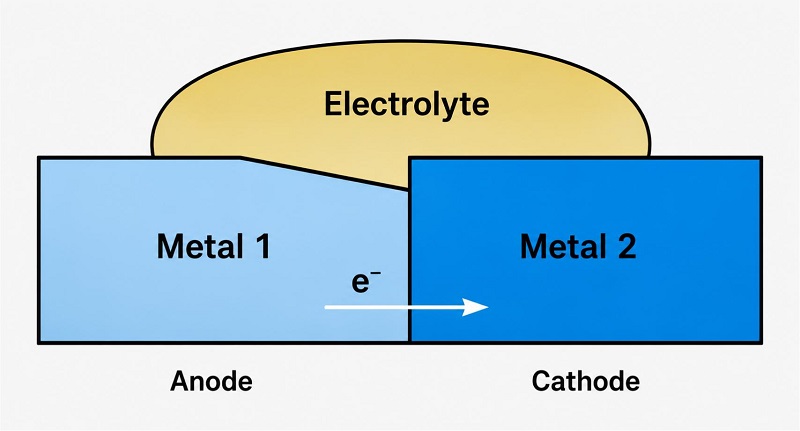
The potential of stainless steel (about+0.1V) is higher than that of zinc (about -0.76V). When the two come into direct contact in a humid environment, zinc will preferentially corrode as the anode (sacrificial protection), while stainless steel is protected as the cathode. The relative reactivity of zinc is the key reason for the first consumption of zinc layer in the stainless steel galvanized steel system. If not controlled, the zinc layer in the connection area may fail prematurely. Therefore, in this combination, the main damaged material is galvanized steel.
Conditional Analysis
We know that the essence of corrosion is the loss of electrons and oxidation of reactive elements.
So, to put the above three conditions in layman’s terms:
The potential difference in condition 1 ensures that electrons e – can flow between the anode (active metal) and cathode (inert metal). There will be no electron movement between elements/materials with the same potential, meaning that no elements will be oxidized and there is no risk of corrosion;
Condition 2 ensures that the two metal materials are in contact – providing a channel for the passage of electrons. If the two materials are not in contact, no matter how large the potential difference is, there will be no electron flow, and naturally no elements will be oxidized, so there is no risk of corrosion;
Condition 3 ensures that the two metal materials are in a corrosive environment. Without a corrosive environment (such as a vacuum environment), there will naturally be no corrosion problem.
By understanding the meanings of these three conditions, it is easy to understand how to avoid contact corrosion.
II, Risk assessment in the scenario of mixed use of galvanized steel and stainless steel
1, The influence of environmental humidity and salinity
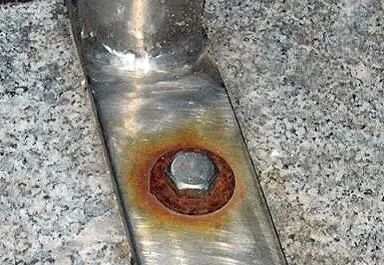
The corrosiveness of the environment is a key factor in determining whether it can be mixed. In dry or generally inland areas, the conductivity of rainwater and condensation is low, and the galvanic corrosion effect is mild. However, in areas with marine or heavy industrial pollution, salt and pollutants significantly increase the conductivity of the water film, greatly enhancing the galvanic corrosion effect. In addition, design defects such as gaps and water accumulation at the connection points can also exacerbate corrosion. So it is not advisable to place mixed connections in blind spots where electrolytes are prone to accumulate.
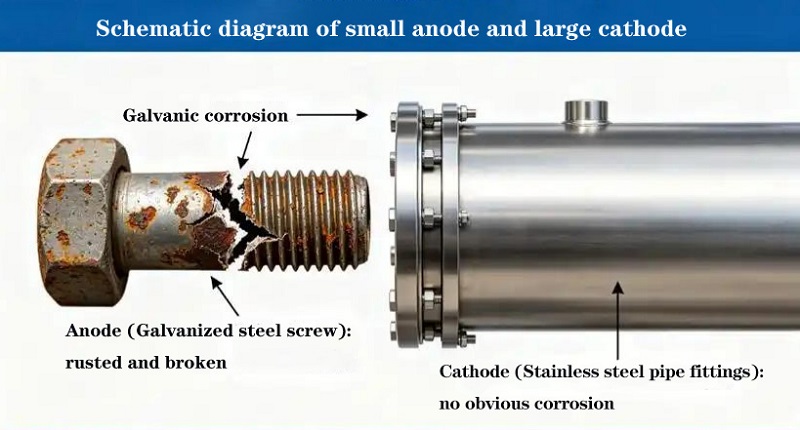
2, Area ratio effect – risk of small anode and large cathode
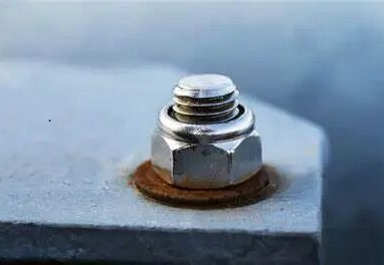
In galvanic corrosion, the area ratio of anode to cathode directly affects the corrosion rate. When the area of the anode (galvanized steel) is relatively small compared to the area of the cathode (stainless steel), the corrosion rate of the anode will significantly accelerate. This effect is particularly prominent in fastener connections: when stainless steel components are fixed with galvanized bolts, the large-area cathode of stainless steel will accelerate the corrosion of large-area galvanized bolts.
3, Special risks in concrete/buried environments
The situation becomes more complicated when stainless steel & galvanized steel are embedded in concrete. Concrete has porosity, and over time, moisture and chloride ions (such as snow melting salts) may infiltrate and come into contact with steel bars, forming a corrosion battery. Although zinc passivation failure in concrete usually takes several decades, it is still necessary to prevent it in advance in coastal bridges or areas where de icing salts are frequently used.
III, Preventive measures: Mixing can be done, but these things must be done correctly
1: Install an insulation layer between two metal materials to implement electrical insulation (preferred measure).
Inserting insulation material between the contact surfaces of galvanized steel and stainless steel is the most effective and direct method to prevent galvanic corrosion.
Common insulation materials include nylon gaskets, rubber gaskets, plastic sleeves, chloroprene rubber strips, etc.
2: Optimize Area Ratio – Principles for Selecting Fasteners.
In the design of connections such as bolts and screws, the principle of “large anode, small cathode” should be followed. Fasteners should be made of metals that are more inert than the substrate or have a potential similar to that of the substrate. Stainless steel components should use stainless steel bolts; Galvanized steel components can use galvanized or mechanically galvanized bolts. The key to this principle is to prevent small fasteners from becoming the focus of corrosion attacks.
3: Isolate one of the materials from the electrolyte (corrosive environment).
In cases where electrical insulation cannot be achieved, a protective coating can be applied to the surface of galvanized steel or stainless steel to prevent electrolyte from contacting the metal surface. Zinc rich primer, epoxy resin coating, powder coating, etc. can be used, and the coating should be regularly maintained to avoid damage.
IV, Practical application suggestions
For different building scenarios and connection types, the following solutions are provided for reference only:
| Application scenarios | Recommended Solution | Explanation |
| Inland dry areas | Can be directly contacted without special isolation | The risk is acceptable under normal atmospheric conditions, and selecting materials according to standards is sufficient |
| Coastal or high humidity areas | Insulation gaskets or sleeves must be installed | The marine environment has high salinity and significantly accelerates galvanic corrosion, requiring isolation |
| Galvanized bolts for stainless steel plates | Stainless steel bolts replace galvanized bolts | Prevent small areas of galvanized bolts from becoming anodes and accelerating corrosion |
| Stainless steel bolts for galvanized steel | Low risk, can be used directly, it is recommended to add insulation gaskets | Suitable for moderate forming, not easy to crack |
| Concrete/Underground Environment | Using the same material or embedding insulation layer in the segment | The electrolyte continues to exist after burial, and long-term corrosion cannot be ignored |
| Architectural exterior surface | Only perform concealed insulation treatment at the connection point | Not affecting the appearance, while meeting the anti-corrosion requirements |
Attention: The above applicability recommendations are mainly based on engineering technical guidelines and publicly published case experiences, without specific additional constraints such as fire and earthquake resistance. Users should make final confirmation according to project requirements and local regulations.
V, FAQ
VI, Summary
Whether stainless steel & galvanized steel can be mixed in construction is not a simple “yes” or “no” issue. It is an environmentally dependent engineering decision that can be effectively controlled through engineering measures. As long as good insulation is achieved and conductive pathways are eliminated, galvanic corrosion will not occur.
In a conventional environment, the corrosion risk of direct contact between the two is low and can be safely used; In corrosive environments such as coastal areas, high humidity, long-term immersion, or heavy industrial pollution, measures such as electrical insulation, optimized area ratio, and coating must be taken for protection.
 English
  Русский
  العربية
  Español
  Français
  فارسی
فارسی  繁體中文
繁體中文  O‘zbekcha
  Tiếng Việt
  Українська
  Türkçe
  ไทย
ไทย  日本語
日本語  한국어
한국어  简体中文
简体中文