
Hot rolling and cold rolling are the two ways flat steel and section steel get their final shape, and the choice between them decides what the steel looks like, how accurate its dimensions are, and what it costs. They are not better or worse than each other. They are built for different jobs. This page explains how each process works, where they split, and how to pick the right one for your order.
What hot rolling and cold rolling mean
Hot rolling forms steel above its recrystallization temperature, where the metal is soft enough to shape in one pass. Cold rolling shapes the same steel at room temperature, after it has already been hot rolled and pickled, using pressure to squeeze it thinner and tighter.
It all comes down to temperature. Hot rolling works at roughly 1000 to 1200 degrees C for steel, far above the roughly 600 degree C recrystallization point, so the steel stays easy to deform. Cold rolling works at or near room temperature, well below that point, so the steel work hardens as it is pressed. Both start from the same slab, but they leave it in very different condition.
For stainless specifically, we cover hot rolled material in our hot rolled stainless steel plate page and cold rolled material in our cold rolled stainless steel sheet page. Britannica covers how stainless steel is produced and why its processing route affects corrosion resistance.
How each process works
Hot rolling starts with a heated slab that runs through roughing and finishing stands to the target thickness, then gets pickled to remove scale. Because it is worked hot, the mill can make it thick and wide without the steel fighting back.
Cold rolling takes that hot rolled, pickled stock and runs it through rollers at room temperature, often several times, to reach a thinner gauge and a smoother face. The metal strain hardens with each pass, which is why cold rolled steel is stronger but also stiffer. After rolling, a skin pass or bright anneal sets the final surface.
Processing temperature: the defining split
This is the line that separates the two. Hot rolling happens above the recrystallization temperature, so new strain free grains form as the steel cools. Cold rolling happens below it, so the deformed grains stay deformed and the steel keeps the extra strength from work hardening.
One correction worth making: cold rolling is not done at sub zero temperatures. The old claim that cold rolling runs “between minus 100 C and room temperature” is wrong. Cold rolling is carried out at room temperature, which for steel is far below the recrystallization range but not below freezing. Keeping that straight avoids confusion when you spec the process.
Rolling force and pressure
Because hot steel flows easily, hot rolling needs less force per pass and can remove a lot of thickness in one go. Cold rolling needs much higher pressure, applied over several passes, because the steel is stiff at room temperature.
That extra force is also why cold rolling holds tighter tolerances. The mill can measure and correct gauge continuously, while hot rolling tolerance is wider because the steel moves and scales at high heat.
Surface finish and appearance
Hot rolled steel ships in a No.1 finish: a matte, grey, pickled face with some texture. It is fine for structure and equipment where the surface is hidden. Cold rolled steel ships in 2B or BA: smooth, brighter, and close to a finished look.
For stainless, the surface decision matters for hygiene and appearance. Our stainless steel surface finish guide walks through No.1, 2B, BA, No.4 and 8K. A brushed stainless steel sheet in No.4 is a cold rolled product taken one step further for visible parts.
Mechanical properties and dimensional tolerance
Cold rolled steel is stronger and harder than hot rolled of the same grade, because work hardening raises yield and tensile strength. It also holds tolerance in the range of plus or minus 0.05 to 0.1 mm, against plus or minus 0.3 to 0.8 mm for hot rolled.
Hot rolled steel is softer and more ductile, which makes it easier to bend, weld and cut in the annealed state. For most structural and tank work that is exactly what you want. We keep both forms for 316 stainless steel sheet and 304 stainless steel sheet.
Residual stress and structural behavior
The two processes leave different internal stress behind. Hot rolled section steel tends to carry a film like residual stress pattern, and its free torsional rigidity is higher, so it resists twisting better. Cold formed thin wall steel can carry bending type residual stress, and it allows local buckling that lets a member use its post buckling strength.
Neither is wrong. They behave differently under load, and the right pick depends on the member and the load case, not on a general rule that one is stronger in every sense.
Cost, lead time and production scale
Hot rolling moves material fast and in volume, so it costs less per kilogram and suits thick, heavy sections. Cold rolling adds steps, so it costs roughly 10 to 25 percent more, but it delivers the surface and tolerance that finished products need.
For stainless, the ASTM A240 certified stainless steel sheet we supply comes in both routes, and the choice usually tracks finish and tolerance rather than thickness alone.
how to choose between hot rolled and cold rolled
Use this short guide.
- Start from thickness. Above about 3 mm, hot rolled is the practical route. Below 3 mm, cold rolled takes over.
- Check the surface. If the part is seen or must stay clean, pick cold rolled 2B or BA. If it is hidden structure, No.1 hot rolled is fine.
- Set the tolerance. Tight dimensions point to cold rolled. Wide tolerance is acceptable for hot rolled structure.
- Weigh cost and volume. Large, thick, cost driven orders suit hot rolled. Precision, visible, lower volume orders suit cold rolled.
- Match the grade. The same stainless steel grade, 304, 316 or 430, is available in both forms, and so is stainless steel pipe made from rolled stock. See the full list in all products.
For fabricated equipment, our sister company builds stainless steel tanks and fermentation tanks from the same 304 and 316L sheet and pipe, and their 304 vs 316 brewery tank guide explains grade choice in that setting.
Performance of the finished product
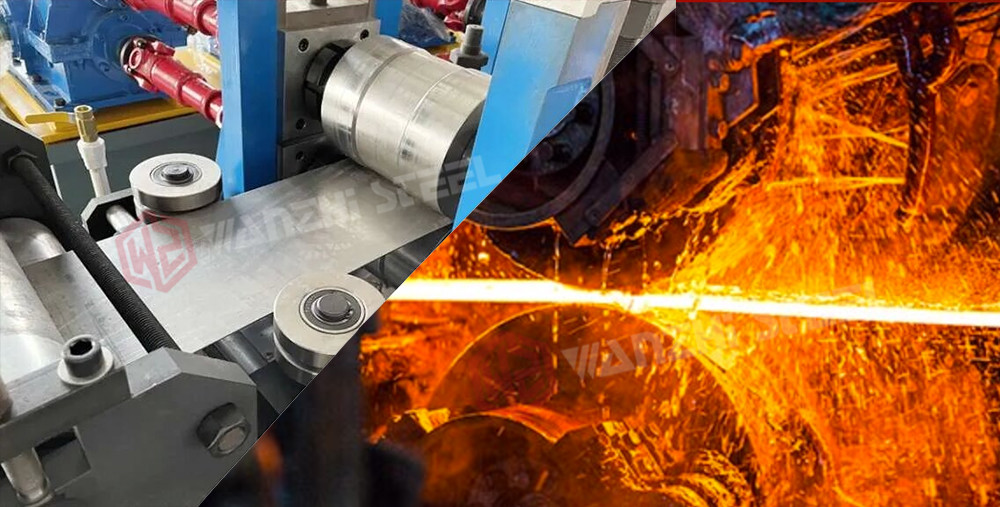
1. Different material properties after processing
Due to different processing temperatures and pressures, the material properties after hot rolling and cold rolling are also different.
After hot rolling, the mechanical properties of the material are relatively poor, but it is easy to deform. so it can be used to manufacture large-scale steel and other products. After cold rolling, the mechanical properties of the material are relatively better and the surface quality is better, so it can be used to manufacture high-precision metal products.
2. Mechanical properties of the material:
Hot rolling has high processing temperatures and relatively low mechanical properties of metals, but during the hot rolling process, mass production can be carried out in a short time and the cost is relatively low. The processing temperature of cold rolling is lower, so the mechanical properties of the metal are relatively high, but the production efficiency is relatively low and the cost is high.
Cold-rolled formed steel allows local buckling in the section, so that the bearing capacity of the member after buckling can be fully utilized; while hot-rolled steel does not allow local buckling in the section.
The causes of residual stress in hot-rolled section steel and cold-rolled section steel are different, so the distribution on the section is also very different. The residual stress distribution on the section of cold-formed thin-walled steel is bending, while the residual stress distribution on the section of hot-rolled steel or welded steel is film. The free torsional rigidity of hot-rolled steel is higher than that of cold-rolled steel, so the torsional resistance of hot-rolled steel is better than that of cold-rolled steel.


3. Surface quality:
The surface quality of hot rolling is relatively poor and often requires subsequent trimming and surface treatment. The surface quality of cold rolling is better, so it can be directly used as a finished product.
Why source from Wanzhi Steel
We are an integrated mill, not a trader, so the same group rolls the slab, finishes the coil, and issues the mill certificate. That keeps grade consistency and lead time under our control. We hold ISO 9001, ISO 14001 and ISO 45001 together with CE and SGS, run in house chemical and mechanical tests, and ship against MTC with optional third party inspection. For the full range, see all products.
Select cold rolling and hot rolling
If your project has started, is about to choose steel, then in the selection of steel, to choose the right steel according to the actual situation of the project. Whether hot rolled steel or cold rolled steel, have their own advantages and disadvantages, the right is the best. Wanzhi Steel as a company with more than ten years of foreign trade experience, here you can get the best quality, the highest price steel. Looking forward to your inquiry.
FAQ
What is the main difference between hot rolling and cold rolling?
Temperature. Hot rolling works above the steel’s recrystallization point, around 1000 to 1200 C, while cold rolling works at room temperature after the steel is already hot rolled and pickled.
Which is stronger, hot rolled or cold rolled steel?
Cold rolled is stronger and harder for the same grade because work hardening raises its yield and tensile strength. Hot rolled is softer and more ductile, which makes it easier to bend and weld.
Is cold rolling done below freezing?
No. Cold rolling is carried out at room temperature, well below the recrystallization temperature but not sub zero. The claim that it runs between minus 100 C and room temperature is a mistake.
Which has the better surface finish?
Cold rolled, by a clear margin. It ships in 2B or BA, smooth and bright, while hot rolled ships in matte No.1 that usually needs further treatment for visible parts.
Which is cheaper?
Hot rolled, typically by 10 to 25 percent, because it uses fewer steps and moves volume fast. Cold rolled costs more but delivers tighter tolerance and a finished surface.
Can stainless steel be both hot and cold rolled?
Yes. Most stainless starts as hot rolled plate or coil, then cold rolling brings it to thin sheet with tight tolerance and a clean face. We supply both routes across 304, 316 and 430.
 English
 Русский
 العربية
 Español
 Français
 فارسی
 繁體中文
 O‘zbekcha
 Tiếng Việt
 Українська
 Türkçe
 ไทย
 日本語
 한국어
 简体中文